
Inventions can either be groundbreaking technologies or life-changing innovations. However, entrepreneurship is a place where even the wackiest ideas can become successful businesses. Consider an example: the pet rock phenomenon of the ’70s netted its creator $1.5 million in a few months.
Then there is the Snuggie, that oddly hybrid of blankets and narrow pajama sleeves that has sold over 30 million units around the world. These whimsical inventions didn’t just capture people’s imaginations; they captured their wallets, too. Another surprising fact is that novelty items make up a chunk of the gift market pie—with a more than $30 billion annual value. Here are 13 quirky inventions that defied logic and made their creators millionaires.
Pet Rock (1975)

Gary Dahl invented the pet rock, which is basically a rock in a box. It was sold as the perfect low-maintenance pet, accompanied by a manual on how to care for it. He sold over one million pet rocks for $4 each.
It had over $15 million sales in its first six months, so this silly concept gained traction. That’s proof that smart marketing can make gold out of even the simplest ideas.
Snuggie (2008)

Allstar Products invented the Snuggie, a blanket with sleeves. At first, it was called a “backward robe,” and then it went viral.
The Snuggie — with 30 million units sold worldwide and $500 million in sales — reminds us that comfort and convenience are gigantic sellers.
The Slinky (1943)

Richard James, an engineer, invented the Slinky by accident when he was designing a spring for naval ships. In the first 90 minutes, only 400 units were sold; after that, an incredible 300-plus million. Since then, the Slinky has made almost $300 million.
In 2000, it was introduced to the National Toy Hall of Fame. Indefinitely entertaining and simple enough to transport to any part of the world, consumer hearts (and wallets) were stolen by this invention.
Mood Ring (1975)

Josh Reynolds introduced the Mood Ring, which alters its color depending on the person wearing it. It is a ring with a thermochromic element that turns color depending on the temperature of the wearer’s finger.
They sold over 40 million rings in three months. In the 70s, the pseudo-science fad of the Mood Ring brought in over $20 million in first-year sales.
Billy the Big Mouth Bass (1999)

The novelty gift that flew off the shelves was Joe Pellettieri’s quirky singing fish, Billy the Big Mouth Bass. In 2000, it made over $100 million and sold over 500,000 units in the first year.
As a gag gift or a way to start a conversation, Billy the Big Mouth Bass became a cultural icon.
Chia Pet (1982)

Joseph Enterprises brought us the Chia Pet, a planter with seeds that grow to resemble fur or hair. The Chia Pet may be silly, but it has proven a perennial favorite, delivering more than $500million in sales.
It has been sold globally for 25 million units. It even made its way into the Smithsonian Museum.
Fidget Spinner (2017)

The fidget spinner’s original design was created by Catherine Hettinger in the 90s, but it was 2017 that made spinners popular, with manufacturers making profits.
In 2017, this craze accounted for 17 percent of total online toy sales and made sales worth over $500 million. It is not scientifically proven, but it was marketed to help ADHD, anxiety, and autism.
Beanie Babies (1993)
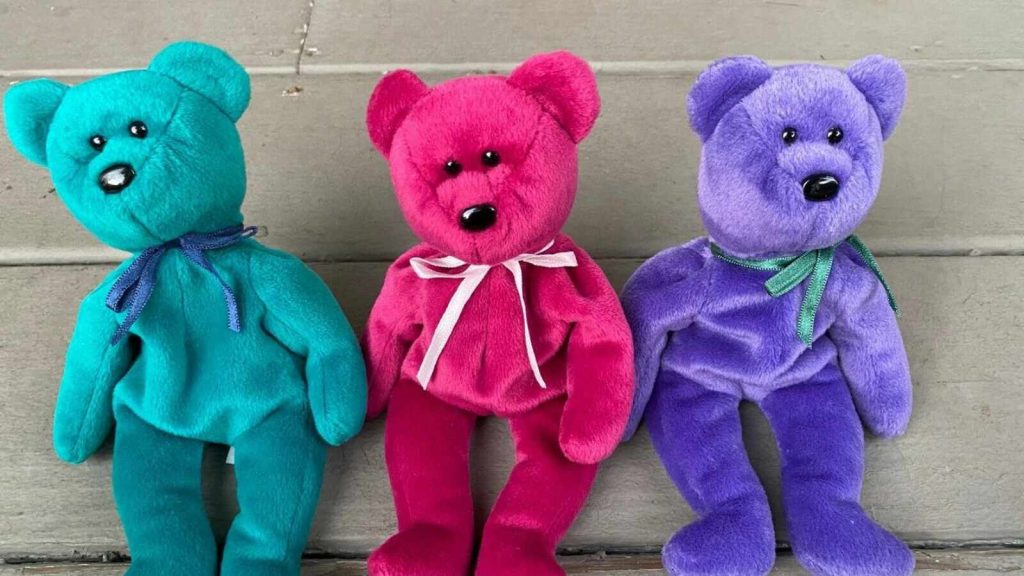
Ty Warner’s Beanie Babies was a craze, and estimated earnings are reported to be over $3 billion. Official figures put Beanie Babies’ sales at almost 25 million units around the world.
Scarcity marketing is the perfect example of why people will pay so much for something. Beanie Babies have become a large part of the collectors market, with many people buying them to invest in.
The Wacky Wall Walker (1983)

This so-called sticky toy was brought to the us by Ken Hakuta from Japan, where it was a hit. Shaped like an octopus, when thrown against a wall, it would ‘walk’ its way down. After it appeared in The Washington Post, the toy sold over 240 million units.
It was also included as a free prize in cereal boxes, which helped gain its popularity. The Wall Walker made $20 million, proof that sometimes, the simplest toys are the most fun.
Ant Farm (1956)

One of the easiest inventions by far was Milton Levine’s Ant Farm: a simple plastic box with sand and ants. Making $20 million, it delighted children and adults alike.
It was often advertised on kids’ TV and has sold over 20 million units. The greatest brilliance of this invention is its educational and entertaining nature, which piques curiosity about nature.
Doggles (1997)

Roni Di Lullo began thinking about these sunglasses for dogs one day when she noticed her pup squinting in the sun. It made $100,000 in sales in its very first year.
Pet pampering is a lucrative market, and Doggles has since raked in over $3 million.
Crazy Frog (2005)

Originally a ringtone, Crazy Frog became an international phenomenon, generating $5.18 million a year as a brand. Erik Wernquist created the catchy tune and quirky animation of the character, which had a lot of viewers.
Based on a net worth calculation, the Crazy Frog is worth $20.73 million.
The Magic 8-Ball (1946)

This fortune-telling toy, created by Albert C. Carter, has been a fixture in homes for decades. It features a 20-sided dice inside a transparent sphere filled with liquid.
You turn the ball then ask a question that can be answered by 20 possible answers. Over $100 million has been made in sales by its simple design and novelty.
Pillow Pets (2003)

Jennifer Telfer brought us this combined bundle of a pillow and stuffed animal, which earned over $300 million in 2010. Pillow Pets has sold more than 30 million units since they started production.
It’s popular because it’s a toy and a practical item for traveling or sleepovers.
GoPro (2002)

Nick Woodman’s small, wearable camera revolutionized action photography. The first GoPro was sold in 2004. Since 2009, it has sold close to 50 million units.
In 2023, GoPro had a revenue of $1 billion. Its rugged design and easy use overcame everyone’s imagination.
Crocs (2002)

Originally an invention by Lyndon Hanson, George Boedecker, and Scott Seamans, Crocs were first mocked but quickly gained worldwide attention. In 2022, Crocs Inc. had a revenue of $3.6 billion.
They sell almost 150 million pairs of shoes every year, indicating that comfort wins over fashion.
Post-it Notes (1974)

These sticky notes came about when Art Fry couldn’t apply his failed adhesive anywhere, and they have earned billions.
According to a market report, the Post-it and Sticky Notes market was valued at $2.37 billion in 2024 globally. Their practicality and versatility have led to their success.
The Banana Phone (2017)

The Banana Phone was a gag gift made by three college students that made over $1.6 million. In 2022, it was featured on Shark Tank. The Banana Phone is a Bluetooth handset that looks like a banana, which connects to your smartphone.
It’s easy to make calls, play music, and interact with Siri or Google Assistant. Its charm is that, at times, silly can be serious business.
The Clapper (1985)

The Clapper was invented by Joseph Pedott, allowing users to turn appliances on or off with a clap, as demonstrated in a demo video uploaded to YouTube. The sale slogan was simply ‘Clap on! Clap off! The Clapper!’
The product sold millions, proof that people love gadgets that simplify life.
Slap Bracelet (1983)

The slap bracelet, by Stuart Anders, was a flexible metal band covered in fabric that would ‘snap’ around your wrist when you ‘slapped’ it. It eventually became a popular fashion accessory and has sold over 100 million units globally.
People still love the satisfying feeling of slapping a bracelet on, even though it’s been banned in some schools for safety reasons.
Disclaimer – This list is solely the author’s opinion based on research and publicly available information.
17 Clever Hacks to Spruce up Your Home Before Guests Show Up

17 Clever Hacks to Spruce up Your Home Before Guests Show Up
2024‘s Most Clever Storage Hacks to Maximize Every Inch of Space

2024‘s Most Clever Storage Hacks to Maximize Every Inch of Space